
Q2 2026 State of AI + The Autonomous Economy

Updated: Jun 30
AI absorbed 89% of all venture capital last quarter. Here is what that means for founders and investors building in the Autonomous Economy.
Every quarter, I publish a full read on where AI stands, where capital is flowing, and what it means for founders and investors building in the Autonomous Economy. Welcome to the Q2 2026 State of AI + AE.
This quarter's report is informed by presentations I gave at Boston Tech Week and New York Tech Week - two of the most concentrated gatherings of AI founders and investors on the East Coast. The data this quarter is unlike anything we have seen before.
If you were in the room, this is your reference. If you weren't, this is the read.
Watch the full presentation:
Q2 2026 State of AI + The Autonomous Economy - webinar recording
Access the full presentation deck
Fill out the short feedback form to get access to the complete slide deck from Boston, Toronto, and New York Tech Week - plus let us know what resonated.
AI is no longer a sector. It's where capital goes by default.
In Q1 2026, $297 billion in total venture capital was deployed globally. AI absorbed $242 billion of that - 89%. In April alone, AI companies took $37 billion out of a $56 billion VC month, making it the third-largest venture month in recorded history.
Crunchbase data shows AI startups captured 89% of all global VC in Q1 2026, up from 55% in Q1 2025 and just 16% in 2021. PitchBook-NVCA's Q1 2026 Venture Monitor confirmed that the statement "AI is the new VC" is now difficult to challenge. This is no longer a hot sector. It is the default destination for institutional capital.

AI Series A rounds are averaging $18.5M versus $12.1M for non-AI startups, a 3.5× premium. Enterprise AI spend is averaging $11.6M per company in 2026, up 65% from $7M in 2025.

Model capability: the arms race is outpacing governance
This quarter produced the most consequential model releases since ChatGPT's launch. GPT-5.4, released March 5, scored 83% on GDPval - matching or exceeding human experts across 44 professions. Harvey's BigLaw Bench evaluation put GPT-5.4 at 91% on transactional legal analysis. GPT-5.5 dropped without warning on April 23rd: 88.7% on SWE-bench Verified, with 60% fewer hallucinations than 5.4. Gemini 3.1 Pro hit 94.3% on GPQA Diamond - the highest score ever recorded on that benchmark - and 77.1% on ARC-AGI-2.

Anthropic confirmed in April 2026 that Claude Mythos 5 - an estimated 10-trillion-parameter model - exists and is in restricted early access with a small group of critical infrastructure organizations via Project Glasswing. It has not been released to the public. For the first time in frontier AI development, the gap between what a lab has built and what it is willing to deploy broadly is measured in a full model generation. That gap is not a talking point. It is a signal about where capability actually is - and why governance infrastructure is the most critical layer of the entire stack right now.
The model arms race is accelerating faster than governance can keep pace. That gap is both a risk and an investment opportunity.
M&A: record volume, new geopolitics
Q1 2026 closed 266 AI M&A deals - up 90% year-over-year, per CB Insights. OpenAI alone made 7 acquisitions in 2026. These companies are being bought at 2–7 years old, long before they reach public markets.


M&A is geopolitical now. China blocked Meta's $2 billion acquisition of Manus AI on April 27 - ordering the deal unwound, while Manus founders had already been barred from leaving the country during the government's investigation. Cross-border AI deals now carry sovereign risk that wasn't priced in 12 months ago.
Seven distinct acquirer lanes are active simultaneously. For early-stage investors, this is the most favorable exit environment we have ever seen.
The IPO window is open
The one weak spot in venture for the past two years has been liquidity. That window is now open.

Cerebras went public on May 14 at $56.4B. SpaceX listed June 12 at $1.75T - the largest IPO in financial history. OpenAI is targeting ~$1T in September, Anthropic in October. The combined pipeline is tracking $1–3T+.
We invested in xAI at the early stage. Watching it become part of a $1.75T entity is a preview of what the AE era looks like at full scale.
Enterprise adoption: the two-tier workforce is real
91% of businesses now use AI, up from 55% in 2024 and 20% in 2020. More than 80% of the Fortune 500 are running AI agents in production. AI super-users are 5× more productive. 60% of C-suite leaders are planning layoffs for employees who won't adopt AI.
McKinsey's 2025 State of AI report: 92% of C-suite leaders are cultivating an "AI elite." AI-skilled workers command a 56% wage premium. The two-tier workforce is not a prediction. It is the current operating reality at the majority of large enterprises.
What is the Autonomous Economy — and how does it actually work?
All of the data above points to the same underlying transition. We are not just in an AI moment. We are entering a new economic era.


The Autonomous Economy is where billions of digital agents and physical robots execute economic work end-to-end, transact with each other, and create value without a human necessarily being in the loop.
We are no longer an AI-native fund. We invest in AE-native startups - companies building for a world where autonomous systems are the primary economic actors, not just tools that assist human workers.
The three phases of the transition
Phase 1 - Human IN the Loop. AI as a smarter tool. You do the work; the AI assists. This phase is largely behind us.
Phase 2 - Human ON the Loop. The copilot era. Where most enterprises sit today. You prompt the system, it executes, you supervise. Real and valuable. Not the endpoint.
Phase 3 - Human OFF the Loop. This is where Fund II invests. Agents understand goals, execute multi-step workflows, integrate with real systems, manage exceptions, and report outcomes. The human shifts from operator to governor. That shift is where the massive productivity multiple lives.
How AI agents trade, negotiate, and transact
Most people understand that agents can complete tasks. Fewer appreciate that agents are already negotiating with each other. Not metaphorically - literally. Right now, in live production environments, AI systems are evaluating options, making offers, countering terms, and settling payments with other AI systems without human involvement at the moment of execution.
The most visible early example is programmatic advertising. Real-time bidding auctions have run on AI-versus-AI dynamics for years - ad budgets competing millisecond by millisecond against algorithmic bidders processing thousands of signals no human could track manually. That was version one. What is being built now is far broader.
An AI agent managing cloud infrastructure can detect a cheaper compute provider, negotiate a rate via API, migrate the workload, and settle the invoice - all while you sleep. An autonomous procurement agent can identify a supply shortage, source three competing vendors, negotiate on delivery time and price, select the best option, place the order, and generate the audit trail - with no human touchpoint at any step. An AI legal agent can review a vendor contract, flag non-standard clauses, propose redlines, and exchange counteroffers with the vendor's AI agent before a human ever sees the final draft. These are not automations following a script. They are agents making contextual decisions, negotiating terms, and executing commercial transactions in real time.
For agents to do this at scale, two infrastructure problems had to be solved: how they communicate across different systems, and how they pay each other without human-controlled bank accounts. Anthropic's MCP (97 million installs, adopted by OpenAI, Google, and Microsoft) handles how agents connect to tools and data sources. Google's A2A protocol handles cross-organizational coordination - how an agent at one company discovers and negotiates with an agent at another. Coinbase's x402 and Google's AP2 settle the payments on-chain using stablecoins, because agents cannot open bank accounts or satisfy KYC requirements at a traditional financial institution.
These are not incremental improvements to existing infrastructure. They are the foundational rails of an economy where software is the primary economic actor. Whoever wins the standards layer wins the most durable position in the entire stack.

The AE Value Stack: our investment framework

Every deal we evaluate maps to one of five layers.
Layer 1 — Intelligence & Compute Substrate.
Models, chips, data centers, energy. The hyperscalers are spending $600B+ in capex this year. Our portfolio company Extropic is pioneering thermodynamic computing chips that could redefine the economics of inference at scale.
Layer 2 — Agent Runtime & Orchestration.
Planning engines, tool interfaces, memory systems, workflow graphs. MCP and A2A are the TCP/IP and HTTP of the agent era.
Layer 3 — The Autonomy Control Plane. (Core Focus)
Identity. Permissions. Policy enforcement. Audit trails. Kill switches. Cost controls. Gartner predicts 40%+ of agentic AI projects will be canceled by 2027 without adequate control infrastructure. Only 1 in 5 companies has mature governance for AI agents. Trust is the #1 adoption blocker. This is where trust gets built - and where we are investing.
Layer 4 — The Machine Workforce. (Core Focus)
How enterprises procure, onboard, manage, and decommission AI agents and robots. The tools to do this don't exist yet at scale. Workday and Salesforce are extending existing products into this space. The purpose-built startups are still being founded. That is exactly where we want to be.
Layer 5 — Autonomous Experiences.
Where SaaS becomes Service as Software. Harper is building a fully autonomous commercial insurance brokerage. Harvey does legal research for 100,000 lawyers at 50 top-100 firms. Foundation Capital estimates this is a $4.6 trillion market opportunity.
We don't invest in AI-native startups. We invest in AE-native startups. The test: if the product disappeared and humans could resume the work, it is a copilot. If the workflow stopped, it is AE-native.
The timing: agents now, robots later

IDC projects 1.3 billion active agents by 2028. Software scales instantly — once the code works, it can be copied a billion times overnight. Goldman Sachs and Morgan Stanley both peg the humanoid mass-market window at the late 2030s. Atoms are heavy. Manufacturing supply chains take decades to ramp.
Invest aggressively in the Agent Economy now. Use those returns to fund the Robot Economy infrastructure over the next decade.
The investing landscape: three layers, three return profiles
Layer 1 — Public Markets.
NVIDIA, Broadcom, TSMC on picks-and-shovels. The hyperscalers as AI monetization plays. Second-derivative outperformers: Micron (+59% YTD), Comfort Systems (+77% YTD). Memory and cooling are monetizing AI before many AI companies themselves are.
Layer 2 — Late-Stage Pre-IPO.
Anthropic heading toward $900B+, OpenAI at $852B. Access through secondaries (Hiive, Forge), late-stage SPVs, or AGIX. Entry price is everything at this stage.
Layer 3 — Early Stage.
This is where asymmetry has migrated. Direct pre-seed and seed deals are how 100–1000× outcomes happen. The smarter LP play: back specialized AI-native funds with real deal flow and reserve discipline, then use co-invest rights to concentrate on the breakouts. Untapped has executed 7 co-invest SPVs for Fund I LPs and expects 10+ in Fund II. Harper is tracking a 10× markup on pre-seed.
The human question
I get asked this every quarter - Boston Tech Week, New York Tech Week, our AGM, even when I've presented to my kids' school. So I'll answer it the same way I always do.
In the AE transition, we don't just lose tasks - we create categories. Agent supervisors. Robot field technicians. AI governance leads. Automation auditors. The work shifts upward and outward.

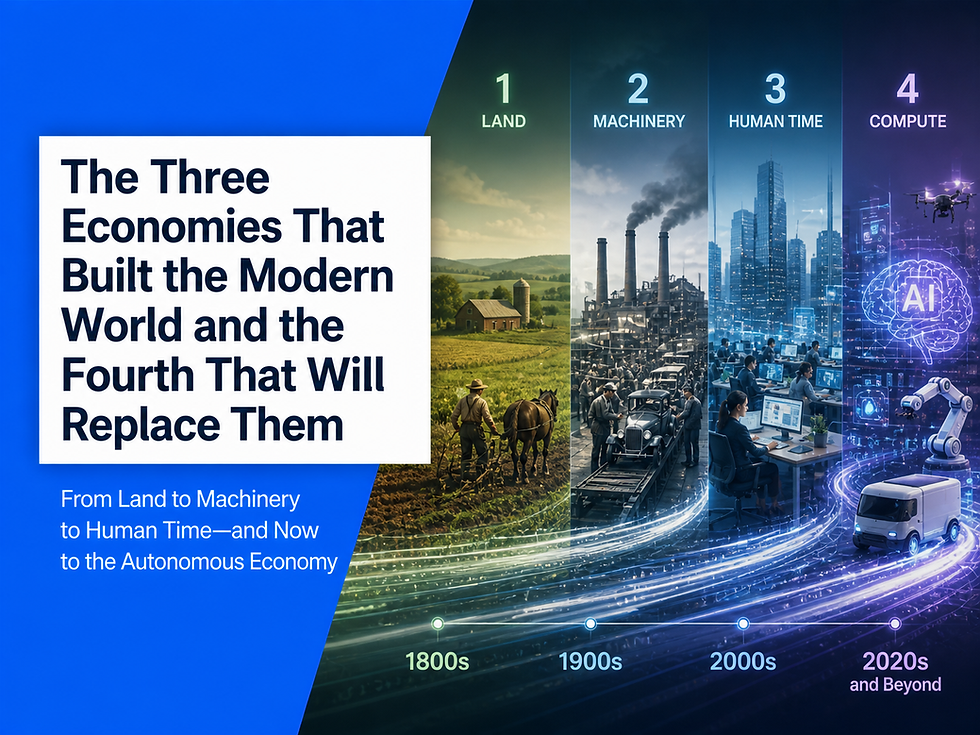
We have been through this before. Agriculture to industrial. Industrial to services. Services to digital. Every transition displaced tasks and created new categories of work at greater scale. The World Economic Forum projects 92 million jobs displaced but 170 million new roles created - a net gain of 78 million positions globally.
I won't pretend the transition is frictionless. It never has been. But when the cost of intelligence approaches zero, the economics of access to education, healthcare, and logistics change fundamentally.
Peter Diamandis: the best way to become a billionaire is to help a billion people. My version: the best way to become a billionaire is to help a billion agents and robots.
If we build the infrastructure that allows a billion agents and a billion robots to do productive, trustworthy work in the world, the human potential that unlocks is almost incomprehensible. The vehicle has evolved - Future of Work, Web3, AI, Agentic, now the Autonomous Economy - but the mission has never changed.
Where Untapped stands - Q2 2026
Untapped Ventures was one of the first funds with a genuine agentic thesis, two years before it became standard vocabulary in venture. Fund I is tracking top-decile for our vintage, with 37 investments including Extropic (thermodynamic computing), Liquid AI (MIT spin-off), 3Laws (robotic safety), Harper (autonomous insurance, YC W25), and EON Systems (whole brain emulation, backed by Larry Page's family office).
If you are a technical founder building at any layer of the AE stack - especially something without a market map yet - pitch us here.
If you are an investor or LP interested in Fund II, reach out directly.
To stay current: this report publishes every quarter. Subscribe to the Untapped newsletter for the Q3 edition when it drops, and follow the Agentic podcast for deep conversations with the founders building this future.
The autonomous economy is not coming. It is here. The question is whether you are building the infrastructure it runs on.
Let's build it together.
George Bandarian II
Founder & General Partner, Untapped Ventures
Frequently asked questions
What is the Autonomous Economy?
The Autonomous Economy is the economic era where billions of digital agents and physical robots execute work end-to-end, transact with each other, and create value without a human in the loop. It is not AI as a tool - it is AI as the primary economic actor, completing tasks, negotiating contracts, and settling payments autonomously.
How do AI agents trade and negotiate with each other?
AI agents negotiate using a combination of communication protocols and decision logic.
Anthropic's MCP and Google's A2A handle how agents discover and coordinate across different systems - including negotiating terms across organizational boundaries. Payment protocols like Coinbase's x402 and Google's AP2 handle how agents settle transactions using stablecoins, since agents cannot satisfy traditional KYC requirements.
Real-world examples already in production include programmatic ad bidding, autonomous procurement, cloud cost optimization, and AI-to-AI contract negotiation.
How much venture capital went into AI in Q1 2026?
AI absorbed $242 billion of the $297 billion in total global VC in Q1 2026 - 81%, per Crunchbase. Four mega-rounds alone - OpenAI ($122B), Anthropic ($30B), xAI ($20B), and Waymo ($16B) - accounted for nearly two-thirds of the total.
What is the AE Value Stack?
Untapped's five-layer investment framework:
Layer 1 (Intelligence & Compute Substrate),
Layer 2 (Agent Runtime & Orchestration),
Layer 3 (Autonomy Control Plane - governance, identity, permissions),
Layer 4 (Machine Workforce),
Layer 5 (Autonomous Experiences).
Fund II concentrates on Layers 3 and 4.
What is the Autonomy Control Plane?
Layer 3 of the AE Value Stack - the governance infrastructure that makes autonomous agent transactions trustworthy at enterprise scale. It covers agent identity, permissions, policy enforcement, audit trails, kill switches, and cost controls. Gartner predicts 40%+ of agentic AI projects will be canceled by 2027 without adequate control infrastructure.
What is the difference between AI-native and AE-native startups?
An AI-native company uses AI to make something better - a human is still doing the work, faster. An AE-native company builds for a world where agents and robots trade, negotiate, and transact autonomously.
The test: if the product disappeared and humans could resume the work, it is a copilot. If the workflow stopped, it is AE-native.
Sources
Crunchbase — Q1 2026 global venture funding (89% AI) · PitchBook-NVCA Q1 2026 Venture Monitor · OpenAI — GPT-5.4 (GDPval 83%, OSWorld 75%) · Harvey — BigLaw Bench (GPT-5.4 91%) · OpenAI — GPT-5.5 (SWE-bench 88.7%) · Google DeepMind — Gemini 3.1 Pro (GPQA Diamond 94.3%) · Bloomberg — China blocks Meta's $2B Manus acquisition · TechCrunch — Cerebras IPO $56.4B · SpaceX — Nasdaq listing June 12, 2026 at $1.75T · McKinsey — State of AI 2025 · McKinsey — Seizing the Agentic AI Advantage · Gartner — 40%+ of agentic projects canceled by 2027 · IDC — 1.3B AI agents by 2028 · Google — Agent2Agent Protocol (A2A) · Google — AP2 Agents-to-Payments Protocol · Coinbase — x402 HTTP-native payment protocol · Workday — Agent System of Record · Salesforce — Agentforce · WEF — Future of Jobs 2025 · CB Insights — Global State of AI Q1 2026 · Brookings — Data center power demand


Comments