
The Autonomous Economy: Why We’re Investing in a World Where Agents and Robots Do the Work

Updated: Jun 30
A few months ago, I made a decision that surprised my team.
I called a complete investment moratorium. We stopped everything. No new deals, no term sheets, no partner meetings. For an entire month, our whole team did nothing but research. We looked at what had shifted in the AI landscape, where the next wave of value creation was forming, and whether our thesis was still ahead of the curve.
The result of that work is what I’m about to share with you.
We are no longer an AI native fund. We now invest in AE startups. Autonomous Economy startups. Companies building for a world where digital agents and physical robots execute economic work end-to-end, transact with each other, and create value without a human necessarily being involved in the process.
This is not a rebrand. It is a recognition that the most important technology shift of our lifetime has graduated from “AI that helps people work” to “AI that does the work.” And the infrastructure required to make that transition safe, trustworthy, and scalable is the single biggest investment opportunity of the next decade.
We’ve Seen This Movie Before
In 1900, a photograph was taken on Fifth Avenue in New York City. The street is packed with horses and carriages. If you look closely, you can spot exactly one automobile in the frame. Thirteen years later, the same street was photographed again. This time, there is one horse. The rest are cars.
That is how fast paradigm shifts happen once the economics flip. And the economics are flipping right now.
We are moving from the old economy, constrained by human biology, time, and headcount, to a new economy constrained by compute, energy, and data. The hyperscalers are spending $600 billion+ in capex this year alone, with roughly 75% of that going directly to AI infrastructure. That is not a bet. That is a rewiring of the global economy’s physical foundation.
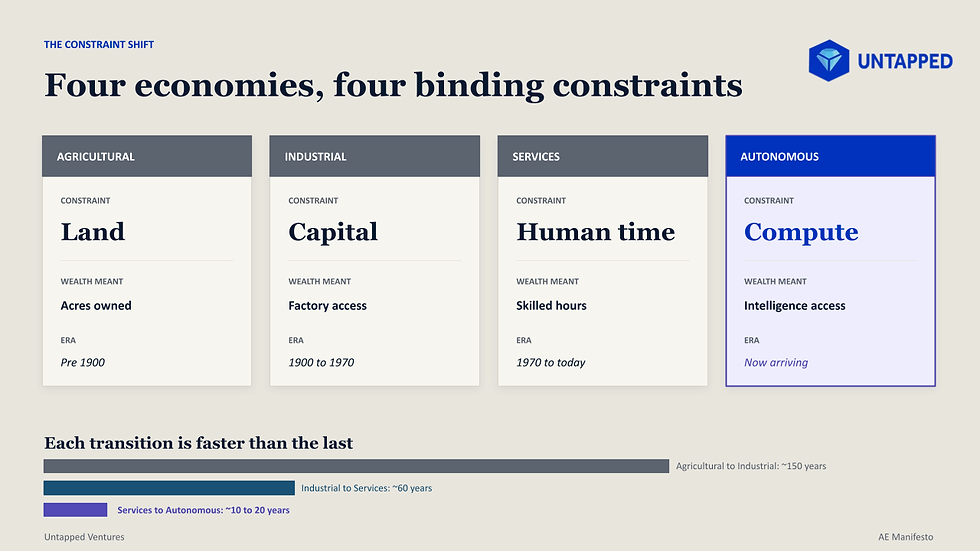
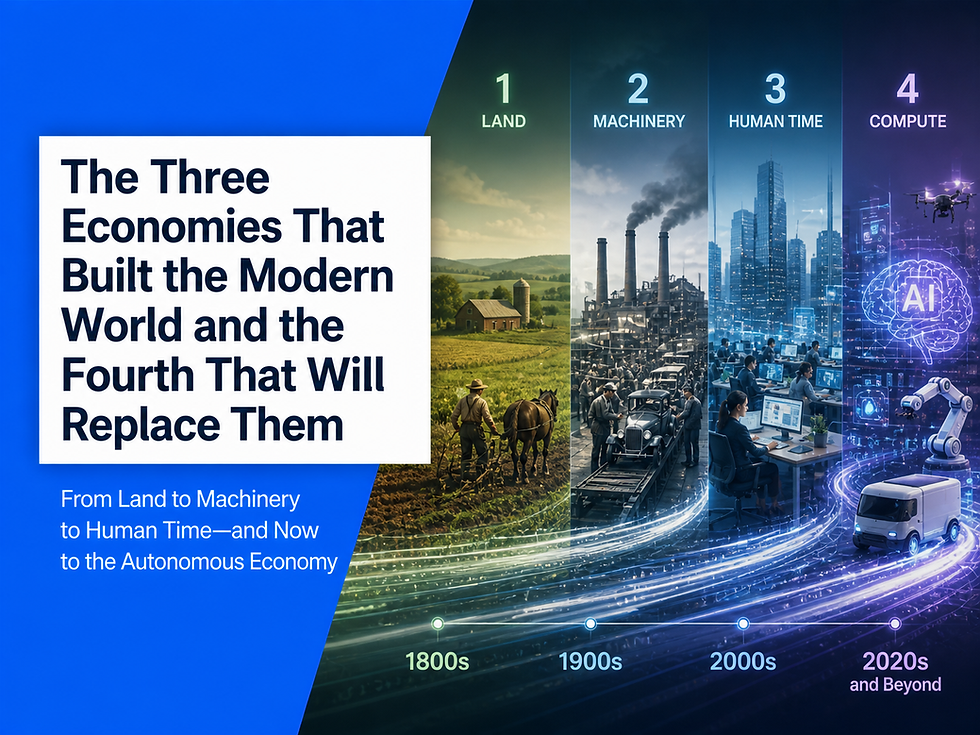
Every great economic era has been defined by its primary constraint. The agricultural economy was constrained by land and weather. The industrial economy was constrained by machinery and capital. The services economy was constrained by human expertise and time. The autonomous economy is constrained by compute cycles, energy supply, and data quality. When the constraint changes, everything built on top of it changes too.
Three Phases of the Transition

To understand where we are, it helps to see the transition in three clear phases.
Phase 1: Human IN the loop. This is what we've gotten used to over the past few years. AI tools are for me. I sit down at my computer, open ChatGPT or Claude, and use it as a copilot. The human does the thinking. The AI assists. This phase is largely behind us.
Phase 2: Human ON the loop. This is where we are right now. I can delegate. I tell an agent what I want done, and it goes and does it while I supervise. My colleague Alejandro runs 14 Claude Code agents simultaneously. Hamlet runs 15 to 20. That is like having 14 to 20 employees working for you around the clock. The human sets the direction. The agents execute. According to McKinsey’s 2025 State of AI report, 88% of organizations now use AI in at least one business function, up from 78% just a year earlier. We are firmly in Phase 2.
Phase 3: Human OFF the loop. This is where it’s going. The agents understand the goals. They write the software, test it, deploy it, monitor user behavior, iterate, and let the humans know: “Hey, I just rolled out version 7.2. Here’s what I changed. Everything’s been tested.”
The human sets the mission. The autonomous system runs the operation. This is the Autonomous Economy.
The Numbers Are Already Staggering
This is not a 2035 prediction. The autonomous economy is being built in real time, and the data points are converging from every direction.
IDC projects 1.3 billion AI agents deployed globally by 2028. The AI agent market is expected to grow from $7.8 billion in 2025 to over $52 billion by 2030, a 46% compound annual growth rate. Gartner predicts that by 2028, 90% of B2B buying will be AI agent intermediated, pushing $15 trillion of B2B spend through agent exchanges. That is not a niche. That is the economy.

Let that number sink in. Fifteen trillion dollars in purchases mediated by AI agents within three years.
On the physical side, Waymo served 14 million fully autonomous trips in 2025 alone, more than tripling the prior year, with 450,000 paid rides per week across five US cities and plans for 20+ more in 2026. Aurora launched the first commercial driverless trucking service on US public highways. Zipline surpassed 2 million autonomous deliveries across seven countries at a $7.6 billion valuation. These are not demos. These are revenue-generating autonomous economic actors.
Meanwhile, AI captured 52.7% of all global venture capital in 2025, the first time any single technology category exceeded half of all VC. In Q1 2026, that number jumped to 80%. The capital markets are pricing this transition in real time.
The Four Pillars of the Autonomous Economy

Through our research, we identified four foundational pillars that define the autonomous economy. Every investment we make maps to one of these pillars.
Pillar 1: Autonomous Intelligent Agents
Digital agents that can reason, plan, use tools, and execute complex workflows without human intervention. This includes everything from autonomous sales agents handling enterprise pipelines to coding agents that build, test, and deploy software independently. Cognition’s Devin grew from $1 million to $73 million in annual recurring revenue in nine months. Harvey serves 100,000 lawyers at 50 of the top 100 law firms. These are not chatbots. These are autonomous economic actors generating measurable value.
Pillar 2: Physical Autonomy and Robotics
Robots and autonomous machines that execute physical labor in the real world. Warehouse robots, autonomous trucks, delivery drones, humanoid robots on factory floors, robotic surgery systems, autonomous farming equipment. Figure AI’s humanoid robots are already deployed at BMW manufacturing facilities. The global humanoid robot market is projected to reach $38 billion by 2035, and the investment pace suggests that estimate may be conservative.
Pillar 3: Secure Economic Infrastructure
This is the one most people miss. If agents and robots are going to do business with each other, they need financial rails. They need ways to negotiate, transact, settle payments, and verify each other’s identities without a human signing off on every transaction. Google launched the Agent Payments Protocol (AP2) in January 2025, an open protocol for AI agent transactions supporting credit cards, stablecoins, and bank transfers, with partners including Mastercard, PayPal, and Coinbase. Coinbase launched the x402 protocol for machine-to-machine micropayments using stablecoins. Olas processes over 2 million automated agent-to-agent transactions monthly across nine blockchains. The plumbing for an agent-driven financial system is being laid right now.
Pillar 4: Autonomous Enterprise Operations
This is how it all translates into the enterprise. Instead of human employees handling each step of a business process with bottlenecks at every handoff, you have swarms of agents executing the entire workflow 24/7. Lead generation passes to sales qualification, passes to contract negotiation, and passes to onboarding. No sick days, no handoff delays, infinite scalability. McKinsey estimates that AI-powered workflows accelerate business processes by 30 to 50% and reduce human time spent on low-value work by 25 to 40%. BCG projects the agentic AI opportunity for enterprise at $200 billion.
The AE Value Stack: Where We Invest

If you put together everything I’ve described, it forms a layered system. We call it the Autonomous Economy Value Stack. This is our investment thesis, visualized. Every deal we evaluate maps to one of these five layers, and the layers we care most about are the ones that don’t have market maps yet.
Layer 1: Intelligence and Compute Substrate
The foundation. Models, chips, data centers, energy infrastructure. This is where the intelligence lives and where the raw processing power comes from. This layer is the most mature and the most crowded. OpenAI, Anthropic, NVIDIA, and the hyperscalers dominate here. We invest selectively in this layer when we see novel compute architectures, like our portfolio company Extropic, which is pioneering thermodynamic computing chips that harness heat rather than fighting it. Their first chip arrived from the foundry just days before our last AGM.
Layer 2: Agent Runtime and Orchestration
The middleware that makes agents work. Planning engines, tool calling interfaces, memory systems, workflow graphs, and sandboxes for safe execution. This is where frameworks like LangChain and CrewAI operate. Two critical protocols are emerging as the TCP/IP and HTTP equivalents for the agent era: Anthropic’s Model Context Protocol (MCP) for connecting agents to tools, and Google’s Agent2Agent Protocol (A2A) for connecting agents to each other across organizational boundaries. Companies like E2B (cloud sandboxes for agents, used by 88% of Fortune 100) and Mem0 (persistent memory layer for agents) are building the critical infrastructure in this layer.
Layer 3: The Autonomy Control Plane
This is where we spend most of our time. And it is the layer that will determine whether the autonomous economy succeeds or fails.
Here is the core insight: enterprises will not deploy autonomous agents at scale until they can answer one question. Who authorized this agent to take this action? Identity, permissions, policy enforcement, evaluations, audit trails, rollback mechanisms, kill switches. These are the new rails that agents need to play nicely with each other and with the humans who still set the goals. Gartner reports that 87% of enterprises lack comprehensive AI security frameworks. Only 1 in 5 companies has mature governance for AI agents. And 45% of agents still authenticate using shared API keys rather than managed identities.
Trust is the number one adoption blocker for autonomous systems. And the control plane is where trust gets built. Think of it this way: we are investing in the choke points of the AE stack. The layers that everything else depends on, but that nobody has built yet.
Forrester formalized the “agent control plane” as a distinct market category in December 2025. Lightspeed and Coatue co-led a $65 million seed round in Sycamore, which is building the “trust and governance layer” for autonomous enterprise AI. Coatue’s Thomas Laffont called it a BFI. I agree with him.
Layer 4: The Machine Workforce
This is the layer I am most excited about because it barely exists yet. Think about it. We spent decades building HR systems, performance management tools, and workforce planning platforms for human employees. Now we are adding an entirely new category of worker: agents and robots. Who manages them? How do you onboard an AI agent? How do you know if it is performing well? What happens when it breaks or drifts? What is its skills registry? How do you manage a fleet of 500 agents across 12 departments? Workday just announced an Agent System of Record, essentially HR for AI agents, covering onboarding, role definition, controls, cost tracking, and compliance. Salesforce frames Agentforce as a “digital workforce” platform. But these are incumbents extending existing products. The purpose-built startups for this layer have not been founded yet. That is where we want to be.
Layer 5: Autonomous Experiences
The top of the stack. The applications that end users and enterprises actually interact with. This is where SaaS gets replaced by what Foundation Capital calls “Service as Software”, a $4.6 trillion opportunity as AI starts eating into in-house salaries and outsourced services. Instead of buying a software tool and hiring people to use it, you buy the outcome directly. The software does the work. Harvey does the legal research. Sierra handles the customer service. Devin writes the code. Our portfolio company Harper is building a fully autonomous commercial insurance brokerage. These are not features added to existing products. These are entirely new companies that could not have existed two years ago.
How We Decide What’s AE Native (and What’s Not)

Not every AI company is an AE company. We needed a way to separate genuine autonomous economy startups from AI wrappers and copilot tools that will get commoditized when the next model update ships.
We use a simple litmus test: if this product disappeared tomorrow, would humans easily resume the work manually?
If the answer is yes, it is a nice-to-have copilot. If the answer is no, because the system is executing work that humans are no longer structured to do, then it is AE native.
A chatbot that helps a salesperson write emails faster? That is a copilot. Useful, but the salesperson can still write the emails without it. An autonomous system that runs an entire sales pipeline from lead discovery through contract execution, where no human salesperson exists in the workflow? That is AE native.
We also look at what we call the Autonomy Density Score: how much of the workflow runs without human intervention, how many decisions the system makes independently, what percentage of the process is end-to-end today versus six months from now, what the control plane story is, and what happens if the system encounters a situation it has never seen before. Founders who score high on these dimensions are building for the world we are investing in.
What We’re Looking For: Our Request for Startups
Here is what we tell our sourcing team every morning: if ChatGPT knows about it, if CB Insights or PitchBook already has the category on a market map, then we are already too late. We only want to invest in something that is not already a category. Ideally, there is not even a market map for it yet.
With that filter in mind, here are the specific company concepts we are actively looking for across the AE value stack:
In the Control Plane Layer
Agent PKI and Identity Service: A certificate authority and identity layer purpose-built for AI agents. Verifiable credentials, permission scoping, and cryptographic proof of authorization. Every enterprise deploying agents will need to answer who authorized this agent, and today, most cannot.
Policy as Code for Agent Autonomy: A declarative policy engine where enterprises define agent behavior boundaries (spending limits, data access, action types, escalation triggers) as code, with real-time enforcement and automatic rollback when policies are violated.
Agent Circuit Breaker Infrastructure: Real-time monitoring that detects anomalous agent behavior across a fleet and can instantly halt, quarantine, or roll back specific agents or entire swarms. The equivalent of circuit breakers in electrical systems, but for autonomous economic actors.
In the Machine Workforce Layer
The Workday for AI Workers: A comprehensive platform for procuring, onboarding, monitoring, and decommissioning AI agents across an enterprise. Performance reviews, cost attribution, skills tracking, and compliance reporting. Enterprises managing 100+ agents need the same operational rigor they apply to human workforce management.
Agent Skills Registry and Marketplace: A standardized registry where agents publish their capabilities, enterprises discover and evaluate them, and transactions are mediated with SLAs and quality guarantees. Think LinkedIn plus Upwork for AI agents.
Mixed Workforce Orchestrator: A platform that schedules, routes tasks, and coordinates handoffs across human workers, digital agents, and physical robots operating in the same workflow. Hybrid teams need a single system that understands the capabilities, costs, and availability of all three worker types.
In the Autonomous Experiences Layer
Autonomous Procurement Agent: A system that identifies needs, sources vendors, negotiates terms within policy constraints, executes contracts, processes payments, and manages vendor relationships end to end. Imagine: an agent detects a supply chain issue, contacts suppliers, dispatches a robot to fix it, verifies the work, and settles the payment. All without a human involved.
Autonomous Compliance Engine: A system that continuously monitors regulatory changes across jurisdictions, automatically updates internal policies, generates compliance documentation, and files required reports. Compliance without a compliance department.
Autonomous FinOps for AI Spend: As enterprises deploy hundreds of agents each consuming compute and making transactions, a platform that monitors, optimizes, and controls all AI-related spending in real time with automatic budget enforcement.
The Human Question
I know what you are thinking. What happens to all the humans?
I get asked this question at every presentation I give. I got asked at our AGM in front of 50 of our investors. I even got asked when I presented this to the teachers at my kids’ school.
Here is my honest answer, in two parts.
First, it is going to create entirely new categories of jobs. Agent supervisors. Automation auditors. AI governance leads. Robot fleet managers. Autonomous system designers. Just like every other technological shift, from agriculture to industrial to services, the transition creates millions of new roles that did not exist before. The World Economic Forum’s Future of Jobs Report 2025 projects 92 million jobs displaced but 170 million new jobs created, a net gain of 78 million positions globally.
Second, and I want to be straightforward about this: we do not know exactly how it all plays out. But we have been through this before. We have seen this movie before. When we went from everybody being a farmer to the industrial age, to services, and now to autonomous systems. Every time, we figured it out. It was not always smooth. But the abundance created by each transition made life better for more people.
As Vinod Khosla puts it, when labor is essentially free, the cost of goods and services drops dramatically. Education becomes free. Healthcare outside of interventional procedures becomes free. The level of income you need in a deflationary economy is very different from what it is today.
That is actually what excites me most about this. Peter Diamandis, someone I have looked up to for a long time, has this famous line: the best way to become a billionaire is to help a billion people.
I have my own version now.
The best way to become a billionaire is to help a billion agents and robots.
I say that with a smile, but I mean it seriously. If we build the infrastructure that allows a billion agents and a billion robots to do productive, trustworthy, valuable work in the world, the amount of human potential that unlocks is almost incomprehensible. That is what this fund is about. That has always been what Untapped is about. Helping humanity reach our untapped potential. The vehicle has evolved, from Future of Work to Web3 to AI to Agentic to now the Autonomous Economy, but the mission has never changed.
Where We Stand
At Untapped Ventures, we have been investing at the frontier of AI since before it was the dominant narrative in venture capital. We were one of the first funds with an agentic thesis, two years before it became the standard vocabulary. Our portfolio includes Extropic (thermodynamic computing), Liquid AI (MIT spin-off rethinking transformer architecture), 3Laws (robotic safety, founded by a Caltech PhD), Harper (autonomous insurance brokerage, YC W25), and EON Systems (whole brain emulation, backed by Larry Page’s family office).
Our $20M Fund I is focused on pre-seed and seed stage AE native startups. We invest $500K to $2M+ in technical founders with deep conviction, urgency to move fast, and a clear answer to the question: what does the control plane look like for what you are building?
Our second fund will go deeper. Agents first, then the infrastructure bets for the physical layer. Because the humanoid robots are coming, Figure and Tesla will win the hardware, but the infrastructure layer that makes enterprises adopt and manage fleets of robots is wide open.
If you are a technical founder building at any layer of the AE value stack, especially if you are building something that does not have a market map yet, we want to meet you.
Pitch us through our submission form. Check out our Agentic podcast for deep conversations with the founders building this future. And follow me on LinkedIn and X for ongoing AE thesis insights, portfolio updates, and provocative questions about where all of this is headed.
The autonomous economy is not coming. It is here. The question is whether you are building the infrastructure it runs on.
Let’s build it together.
George Bandarian II
Founder & General Partner, Untapped Ventures
Frequently asked questions
What is the Autonomous Economy?
The Autonomous Economy is the economic era where billions of digital agents and physical robots execute work end-to-end, transact with each other, and create value without a human in the loop. It is not AI as a tool - it is AI as the primary economic actor, completing tasks, negotiating contracts, and settling payments autonomously.
What is an AE-native startup?
The Autonomous Economy is a world where digital agents and physical robots execute economic work end-to-end, transact with each other, and create value without a human necessarily involved. It marks a shift from "AI that helps people work" to "AI that does the work," constrained by compute, energy, and data rather than human time.
What are the three phases of AI adoption?
The three phases are Human IN the loop (AI as copilot, the human does the thinking), Human ON the loop (you delegate to agents and supervise their execution), and Human OFF the loop (agents run entire operations autonomously and report results). Most organizations are currently in Phase 2, with Phase 3 defining the Autonomous Economy.
What are the four pillars of the Autonomous Economy?
The four pillars are Autonomous Intelligent Agents (digital agents that reason and execute workflows independently), Physical Autonomy and Robotics (robots performing physical labor in the real world), Secure Economic Infrastructure (financial rails letting agents transact with each other), and Autonomous Enterprise Operations (swarms of agents running entire business processes 24/7).
What is the AE Value Stack?
The AE Value Stack is Untapped Ventures' five-layer investment framework for the Autonomous Economy: Intelligence and Compute Substrate (models and chips), Agent Runtime and Orchestration (middleware connecting agents to tools), the Autonomy Control Plane (identity, permissions, and trust), the Machine Workforce (managing agents and robots like employees), and Autonomous Experiences (the applications people actually use).
What is the Autonomy Control Plane and why does it matter?
The Autonomy Control Plane is the governance layer that answers a critical question for any enterprise deploying agents: who authorized this agent to take this action? Gartner reports 87% of enterprises lack comprehensive AI security frameworks, making trust the primary blocker to scaling autonomous systems and the layer Untapped Ventures prioritizes most.
Will AI agents and robots replace human jobs?
History suggests transitions like this create new categories of jobs even as old ones disappear. The World Economic Forum projects 92 million jobs displaced but 170 million new jobs created by AI, a net global gain of 78 million positions, similar to how agriculture, industrial, and services transitions each created roles that didn't previously exist.
Who is Untapped Ventures and what do they invest in?
Untapped Ventures is an early-stage venture capital firm investing in Autonomous Economy startups, particularly those building the Autonomy Control Plane and Machine Workforce layers of infrastructure. Fund I deploys $500K to $2M+ checks into pre-seed and seed-stage technical founders building systems with no existing market map.
What does Untapped Ventures look for in startups?
Untapped Ventures looks for founders building categories that don't yet exist on market maps from firms like CB Insights or PitchBook, evaluated using an "Autonomy Density Score" measuring how much of a workflow runs without human intervention. Priority areas include agent identity and PKI, policy-as-code engines, and machine workforce management platforms.

Bài chia sẻ này ngắn gọn mà dễ hiểu thật, mình đọc cái là bắt được ý chính luôn, cảm ơn bạn nhé. Mình thì có thói quen xem thống kê XSMB hằng ngày để theo dõi cho tiện, nhưng hồi trước cứ phải mở vài nơi khác nhau nên khá mất thời gian. Dạo này mình chuyển sang tự ghi lại số liệu theo từng ngày, lúc cần chỉ việc mở ra xem lại, khỏi phải lục lọi từ đầu. Thỉnh thoảng bạn bè hỏi thì mình cũng gửi cho họ đúng đường mình hay dùng là https://soicau247.com/xs-minh-ngoc-hom-nay.html để họ tự đối chiếu cho nhanh. Ai hay cập nhật mỗi ngày chắc hiểu cảm giác muốn mọi thứ gọn…